
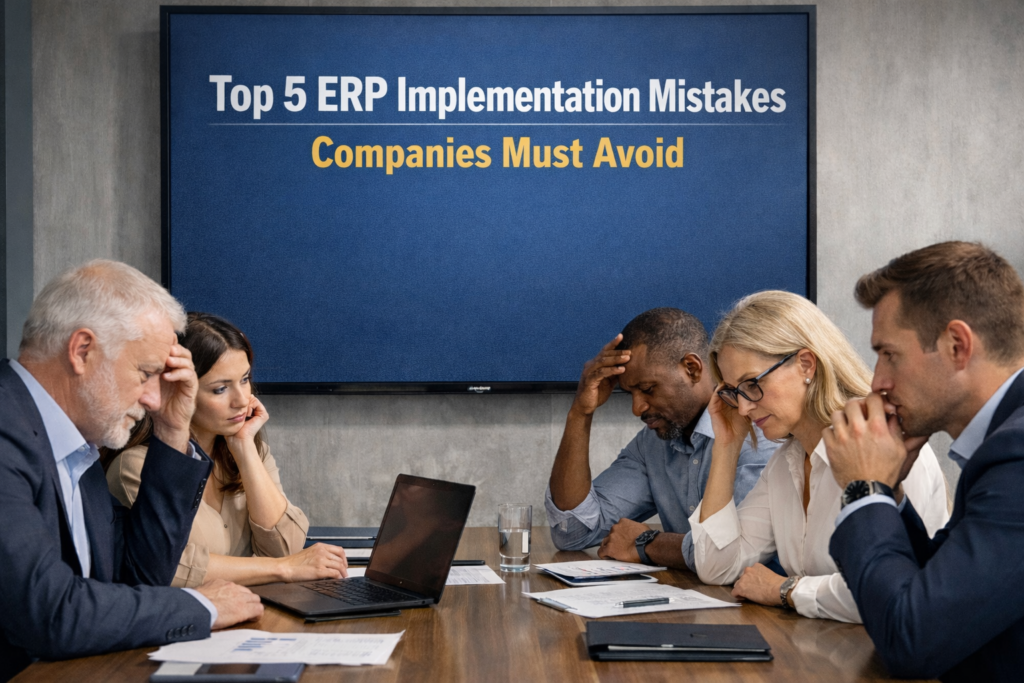
Top 5 ERP Implementation Mistakes Companies Must Avoid
If you are searching for erp implementation mistakes, the most important factor is not just the software you choose, but how effectively it is implemented.
Many mid-sized and enterprise companies across the USA invest heavily in ERP systems expecting operational efficiency, real-time visibility, and scalable growth. Yet, a significant percentage of ERP projects either fail, exceed budgets, or deliver far less value than expected.
The reason is rarely the software itself.
ERP failures almost always stem from poor implementation strategy, lack of alignment, and weak execution frameworks.
Whether you are evaluating erp implementation companies usa, considering an odoo implementation partner usa, or working with erp implementation consultants, understanding what not to do is just as important as knowing best practices.
This guide will walk you through the top ERP implementation mistakes, how to avoid them, and how to ensure your ERP investment delivers measurable business outcomes.
The most common ERP implementation mistakes include unclear business requirements, choosing software before defining processes, underestimating implementation complexity, lack of executive alignment, poor data migration planning, and inadequate change management.
ERP systems rarely fail because of technology. They fail due to weak implementation strategy and execution.
Companies that work with experienced erp implementation consultants or structured partners—such as implementation-focused firms—tend to achieve significantly better outcomes by reducing risk, improving adoption, and accelerating ROI.
What is ERP Implementation
ERP implementation is the process of integrating business processes, data, and systems into a unified platform to improve operational efficiency, visibility, and decision-making.
However, from an executive perspective, ERP implementation is not an IT project—it is a business transformation initiative.
Key business outcomes of ERP implementation:
- Unified operations (finance, inventory, sales, HR)
- Real-time reporting and visibility
- Improved decision-making
- Reduced operational inefficiencies
- Scalable infrastructure for growth
👉 Critical insight:
ERP success depends more on implementation than software.
Core Section: Top ERP Implementation Mistakes Companies Must Avoid
1. Lack of Clear Problem–Solution Alignment
One of the biggest ERP implementation mistakes is starting with software instead of the problem.
Many companies ask:
“Which ERP is best?”
Instead of:
“What operational problems are we solving?”
Why this is dangerous:
- Leads to wrong software selection
- Misaligned expectations
- Low ROI realization
Correct approach:
- Define core business challenges:
- Inventory inefficiencies
- Lack of reporting visibility
- Disconnected systems
- Map ERP capabilities to these problems
2. Choosing Software Before Defining Business Processes
Companies often jump into selecting ERP platforms (like Odoo, NetSuite, SAP) without clearly documenting their workflows.
Impact:
- Customization chaos
- Implementation delays
- Poor system adoption
What should happen instead:
- Document current processes
- Identify inefficiencies
- Define future-state workflows
👉 ERP should adapt to your business—not the other way around.
3. Underestimating Implementation Complexity
ERP is not plug-and-play.
It involves:
- Data migration
- Process redesign
- Integration with existing tools
- User training
- Testing and validation
Common misconception:
“ERP can be implemented in a few weeks.”
Reality:
ERP implementation can take:
- 3–6 months (mid-size companies)
- 6–12+ months (complex organizations)
4. Weak Executive Alignment and Ownership
ERP projects often fail when leadership is not actively involved.
Symptoms:
- Conflicting priorities across departments
- Delayed decision-making
- Lack of accountability
Best practice:
- Assign executive sponsor (CEO/COO)
- Define clear ownership structure
- Align ERP goals with business strategy
5. Poor Data Migration Strategy
Data migration is one of the most underestimated aspects.
Common issues:
- Inaccurate data
- Duplicate records
- Incomplete datasets
Consequences:
- Incorrect reporting
- Operational confusion
- Loss of trust in ERP system
Solution:
- Clean data before migration
- Validate datasets
- Run parallel testing
6. Ignoring Change Management
ERP changes how people work.
If employees are not prepared:
- Adoption drops
- Resistance increases
- Productivity declines
Key elements of change management:
- Training programs
- Clear communication
- Role-based onboarding
7. Choosing the Wrong ERP Implementation Partner
This is one of the most critical mistakes.
Even the best ERP software fails with poor implementation partners.
Why this matters:
- ERP success depends on execution
- Partners define workflows, integrations, and adoption
Insight:
Implementation-focused partners like OdooVizion play a key role in ensuring ERP success through structured execution, customization, and post-go-live support.
ERP Implementation Approaches Comparison
| Approach | Pros | Cons | Best For |
|---|---|---|---|
| In-house implementation | Full control | High risk, lack of expertise | Large enterprises with IT teams |
| Freelance consultants | Lower cost | Limited scalability | Small projects |
| ERP implementation firms | Structured execution | Higher cost | Mid to large companies |
| Certified partners (e.g., Odoo partners) | Expertise + support | Requires evaluation | Growth-stage businesses |
👉 Companies working with erp implementation firms or certified partners typically achieve faster and more stable outcomes.
Cost, Timeline, and ROI of ERP Implementation
ERP Implementation Cost (USA)
Typical ranges:
- Small business: $25,000 – $75,000
- Mid-size companies: $75,000 – $250,000
- Enterprise: $250,000+
Factors affecting cost:
- Customization level
- Number of users
- Integrations required
- Industry complexity
ERP Implementation Timeline
| Company Size | Timeline |
|---|---|
| Small | 2–4 months |
| Mid-size | 4–8 months |
| Enterprise | 8–12+ months |
Expected ROI
ERP ROI typically comes from:
- Cost reduction
- Productivity improvement
- Inventory optimization
- Faster decision-making
ROI timeline:
- Initial ROI: 6–12 months
- Full ROI: 12–24 months
👉 Faster ROI is achieved with structured implementation.
Common ERP Implementation Mistakes
Let’s summarize the most critical mistakes:
- No clear business problem defined
- Selecting software before process mapping
- Underestimating implementation complexity
- Weak leadership involvement
- Poor data migration planning
- Ignoring user adoption
- Choosing the wrong implementation partner
👉 Key principle:
ERP doesn’t fail because of software—it fails because of poor implementation.
How to Choose the Right ERP Implementation Partner
Choosing the right partner is one of the most important decisions in your ERP journey.
Checklist for evaluation:
1. Industry Experience
- Have they worked in your industry?
- Do they understand your workflows?
2. Case Studies
- Real project examples
- Measurable outcomes
3. Implementation Methodology
- Structured phases:
- Discovery
- Planning
- Configuration
- Testing
- Go-live
4. Customization Capability
- Ability to adapt ERP to your processes
5. Integration Expertise
- CRM, accounting, ecommerce, etc.
6. Post-Implementation Support
- Training
- Maintenance
- Upgrades
7. Communication & Transparency
- Clear timelines
- Defined deliverables
👉 Companies that work with structured ERP partners such as OdooVizion tend to achieve better long-term outcomes.
Industry Relevance: ERP Implementation Use Cases
Manufacturing
Challenges:
- Production visibility
- Inventory tracking
- Supply chain coordination
ERP benefits:
- Real-time production monitoring
- Inventory optimization
- Demand forecasting
Retail & Ecommerce
Challenges:
- Multi-channel inventory
- Order management
- Customer data fragmentation
ERP benefits:
- Unified inventory
- Automated order processing
- Centralized reporting
Service Companies
Challenges:
- Resource management
- Project tracking
- Billing inefficiencies
ERP benefits:
- Project visibility
- Resource allocation
- Automated invoicing
Strategic Insight for Decision-Makers
If you are evaluating:
- erp implementation companies usa
- odoo erp implementation services
- erp implementation consultants
You must understand:
The real differentiator is not the ERP software—it is the implementation partner and execution framework.
Implementation-focused partners like OdooVizion help businesses achieve better ERP outcomes by combining:
- structured methodology
- industry expertise
- customization capability
Conclusion
ERP implementation is one of the most impactful decisions a company can make—but also one of the most complex.
Most failures are not due to technology limitations but due to:
- poor planning
- weak execution
- lack of alignment
To avoid the most common erp implementation mistakes, companies must:
- start with business problems
- define clear processes
- choose the right implementation partner
- prioritize adoption and change management
👉 Final takeaway:
ERP success depends more on implementation than software.
Companies that treat ERP as a strategic transformation—and partner with experienced implementation experts—consistently achieve better results, faster ROI, and long-term scalability.
FAQs
1. What is ERP implementation?
ERP implementation is the process of integrating business processes, data, and systems into a centralized platform to improve operational efficiency, visibility, and decision-making.
2. How long does ERP implementation take?
ERP implementation typically takes:
- 3–6 months for mid-size companies
- 6–12+ months for complex organizations
Timeline depends on customization, integrations, and business complexity.
3. What are the biggest ERP implementation mistakes?
The most common mistakes include:
- unclear requirements
- poor process mapping
- weak data migration
- lack of leadership involvement
- choosing the wrong implementation partner
4. How to choose an ERP implementation partner?
Choose a partner based on:
- industry experience
- case studies
- structured methodology
- integration expertise
- post-go-live support
5. What is Odoo ERP implementation?
Odoo ERP implementation involves configuring, customizing, and deploying the Odoo platform to manage business operations such as accounting, inventory, sales, and CRM in a unified system.
6. What is the cost of ERP implementation in the USA?
ERP implementation costs typically range from:
- $25,000 to $250,000+
depending on company size, complexity, and customization needs.
7. Why do ERP implementations fail?
ERP implementations fail due to:
- lack of planning
- poor execution
- inadequate training
- weak partner selection
ERP systems rarely fail because of software—they fail due to implementation issues.