
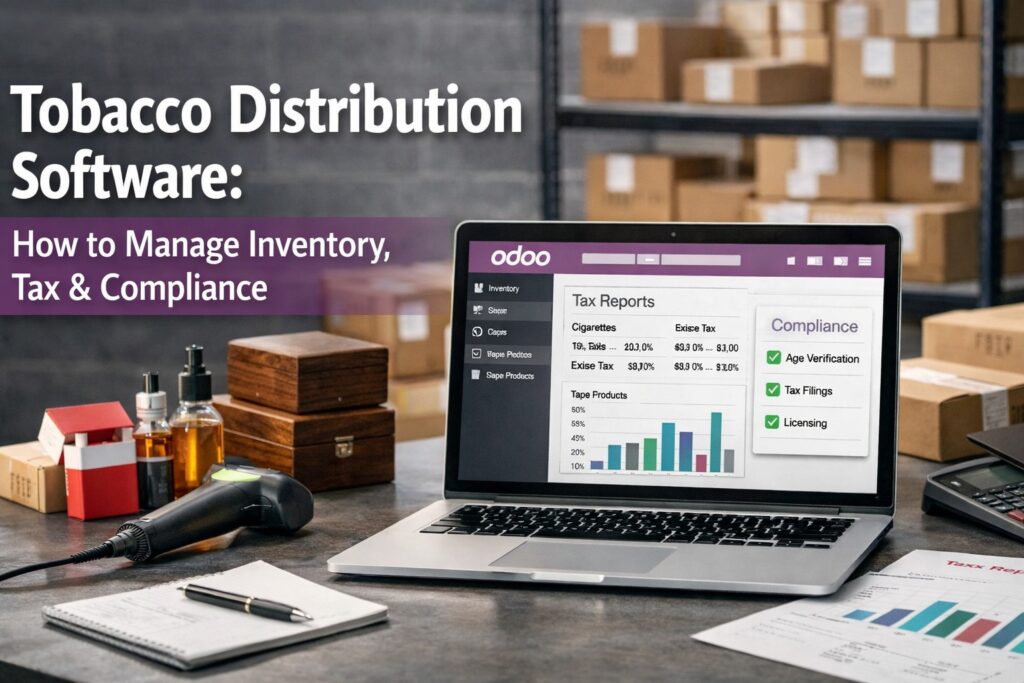
Tobacco Distribution Software: How to Manage Inventory, Tax & Compliance
Tobacco distribution is one of the most complex segments within wholesale operations. It combines high-volume inventory movement, strict regulatory oversight, multi-state tax obligations, and detailed compliance reporting. For decision-makers evaluating digital transformation, the question is no longer whether to adopt ERP—but how to implement the right system effectively.
Odoo ERP for tobacco business has emerged as a practical solution for companies seeking centralized control over inventory, tax compliance, and operational visibility. But software alone does not solve the problem. The real value lies in how well it is implemented and aligned with business processes.
This article breaks down how ERP systems—specifically Odoo—help tobacco distributors manage compliance and operations, while guiding you on how to evaluate the right implementation approach.
How does Odoo ERP help tobacco businesses manage compliance and operations?
Odoo ERP helps tobacco businesses manage compliance and operations by centralizing inventory, automating tax calculations, and enabling real-time reporting across multiple locations. It integrates sales, warehouse, accounting, and compliance workflows into a single system, reducing manual errors and ensuring regulatory alignment.
For tobacco distributors, this includes tracking product movement across warehouses, managing tax variations by state, and generating compliance-ready reports such as MSA filings. The system also improves operational efficiency by automating order processing, synchronizing inventory, and providing leadership with real-time dashboards.
When implemented correctly, Odoo ERP transforms fragmented processes into a unified operational framework, making compliance easier and business decisions faster.
What is Odoo ERP for Tobacco Business?
Odoo ERP for tobacco business refers to the customized implementation of the Odoo ERP platform tailored specifically for tobacco distributors, wholesalers, and multi-location operations.
Unlike generic business software, ERP systems are designed to:
- Integrate all core operations into one system
- Eliminate data silos between departments
- Provide real-time visibility across inventory, finance, and sales
For tobacco businesses, this becomes even more critical due to:
- Regulatory reporting requirements (e.g., MSA compliance)
- Complex tax structures across states
- High inventory turnover with strict tracking needs
A properly implemented ERP ensures that every transaction—from procurement to sales—is recorded, validated, and aligned with compliance standards.
Why It Matters
USA Market
Tobacco distributors in the United States operate under strict federal and state regulations. Challenges include:
- Multi-state tax compliance
- Master Settlement Agreement (MSA) reporting
- Excise tax tracking
- Distributor licensing requirements
Manual systems or disconnected tools increase the risk of:
- Compliance errors
- Financial penalties
- Operational inefficiencies
UAE & Global Distribution Context
While MSA reporting is US-specific, similar complexities exist globally:
- VAT compliance
- Import/export regulations
- Multi-warehouse inventory management
For both regions, ERP becomes essential for:
- Standardizing operations
- Reducing compliance risks
- Scaling distribution networks
Core Capabilities of Odoo ERP for Tobacco Business
1. Centralized Inventory Management
Tobacco distributors often manage:
- Multiple warehouses
- High SKU volumes
- Batch and lot tracking
Odoo ERP enables:
- Real-time stock visibility
- Batch-level tracking
- Automated replenishment
This ensures accurate inventory across all locations.
2. Tax & Compliance Automation
One of the most critical aspects of ERP for Tobacco Industry is handling tax complexity.
Odoo supports:
- State-specific tax rules
- Automated tax calculations
- Compliance-ready reporting
This reduces dependency on manual calculations and spreadsheets.
3. MSA Reporting & Regulatory Compliance
For US-based tobacco businesses, MSA reporting is mandatory.
ERP systems help by:
- Tracking sales data accurately
- Generating structured reports
- Maintaining audit-ready records
This ensures businesses remain compliant without operational disruption.
4. Multi-Warehouse Operations
Distributors often operate across:
- Regional warehouses
- Distribution hubs
- Retail supply chains
Odoo ERP enables:
- Inter-warehouse transfers
- Centralized stock control
- Location-based reporting
5. Order & Distribution Management
For ERP Software for Tobacco Distributors, order processing efficiency is critical.
Odoo provides:
- Automated order workflows
- Real-time order tracking
- Integrated invoicing
This improves fulfillment speed and accuracy.
6. Financial Integration
Odoo connects:
- Sales
- Inventory
- Accounting
This allows:
- Real-time financial reporting
- Accurate profit tracking
- Automated reconciliation
7. Data Visibility & Decision Intelligence
Leadership teams need:
- Dashboards
- KPIs
- Operational insights
Odoo delivers:
- Real-time analytics
- Custom reports
- Forecasting tools
ERP Implementation Partner
Even the most advanced ERP system can fail without proper implementation.
This is where experienced ERP implementation firms play a crucial role. A structured approach ensures that the ERP aligns with business processes, compliance requirements, and operational workflows.
OdooVizion, working extensively with Odoo ERP for tobacco business, focuses on:
- Industry-specific configuration
- Compliance-driven workflows
- Scalable architecture for distribution businesses
The success of ERP adoption depends less on the software itself and more on how effectively it is implemented.
Comparison: ERP vs Traditional Systems
| Criteria | Traditional Systems | Odoo ERP Approach |
|---|---|---|
| Inventory Tracking | Manual / fragmented | Real-time centralized |
| Tax Management | Manual calculations | Automated compliance |
| Reporting | Delayed / inconsistent | Instant dashboards |
| Scalability | Limited | Highly scalable |
| Integration | Disconnected tools | Unified system |
Cost, Timeline & ROI
Implementation Cost
ERP implementation costs vary based on:
- Business size
- Number of users
- Customization requirements
Typical range:
- Mid-size distributors: $15,000 – $75,000
- Larger operations: $75,000+
Timeline
Implementation timelines depend on complexity:
- Small deployments: 6–10 weeks
- Mid-size operations: 3–5 months
- Complex multi-location setups: 6+ months
ROI
ERP delivers measurable ROI through:
- Reduced compliance risk
- Improved operational efficiency
- Better inventory control
- Faster decision-making
Most businesses see ROI within 6–12 months.
Common Mistakes in ERP Implementation
- Choosing software without industry fit
- Ignoring compliance requirements
- Underestimating implementation complexity
- Lack of internal process alignment
- Poor data migration planning
- Inadequate training
- No clear implementation roadmap
ERP success depends more on execution than selection.
How to Choose the Right ERP Implementation Partner
When evaluating partners, consider:
1. Industry Experience
Do they understand tobacco distribution workflows?
2. Implementation Methodology
Do they follow a structured process?
3. Case Studies
Have they delivered similar projects?
4. Customization Capability
Can they adapt ERP to your processes?
5. Support & Training
Do they provide long-term support?
OdooVizion, while implementing Odoo ERP for tobacco business, emphasizes structured deployment, ensuring compliance and operational alignment from day one.
Industry Use Cases
1. Tobacco Distributor (USA)
Challenges:
- MSA reporting
- Multi-state tax
- Inventory tracking
Solution:
- Automated compliance workflows
- Centralized reporting
- Real-time inventory visibility
2. Wholesale Distribution Business
Challenges:
- Multiple warehouses
- Disconnected systems
- Order inefficiencies
Solution:
- Unified ERP system
- Automated order processing
- Inventory synchronization
3. Multi-Location Retail Supply Chain
Challenges:
- Stock inconsistencies
- Reporting delays
- Operational inefficiencies
Solution:
- Centralized control
- Real-time dashboards
- Scalable operations
FAQ Section
1. How does Odoo ERP help tobacco businesses manage compliance?
Odoo ERP centralizes data, automates tax calculations, and generates compliance-ready reports, ensuring regulatory alignment.
2. Is Odoo ERP suitable for tobacco distributors?
Yes, it is highly adaptable and can be customized for inventory tracking, tax management, and compliance requirements.
3. What makes ERP critical for tobacco businesses?
Strict regulations, tax complexity, and high inventory movement make ERP essential for accuracy and compliance.
4. How long does ERP implementation take?
Typically between 3–6 months, depending on business complexity.
5. What is the role of an ERP implementation partner?
They configure, customize, and align the ERP system with business processes, ensuring successful adoption.
6. Can ERP handle multi-state tax compliance?
Yes, ERP systems like Odoo automate tax rules and reporting across different jurisdictions.
7. Why do ERP implementations fail?
Failures usually occur due to poor planning, lack of expertise, and inadequate implementation strategy.
Conclusion
Tobacco distribution is not just about moving products—it’s about managing compliance, maintaining accuracy, and scaling operations efficiently.
Odoo ERP for tobacco business provides the technological foundation to handle these challenges, but technology alone is not enough. The real differentiator is implementation.
Businesses that succeed with ERP focus on:
- Structured implementation
- Industry-specific customization
- Long-term operational alignment
OdooVizion, working closely with Odoo ERP for tobacco business, positions itself as a partner focused on delivering not just software, but successful ERP transformation.
In high-risk, compliance-driven industries like tobacco distribution, ERP is not an expense—it is a strategic necessity.