
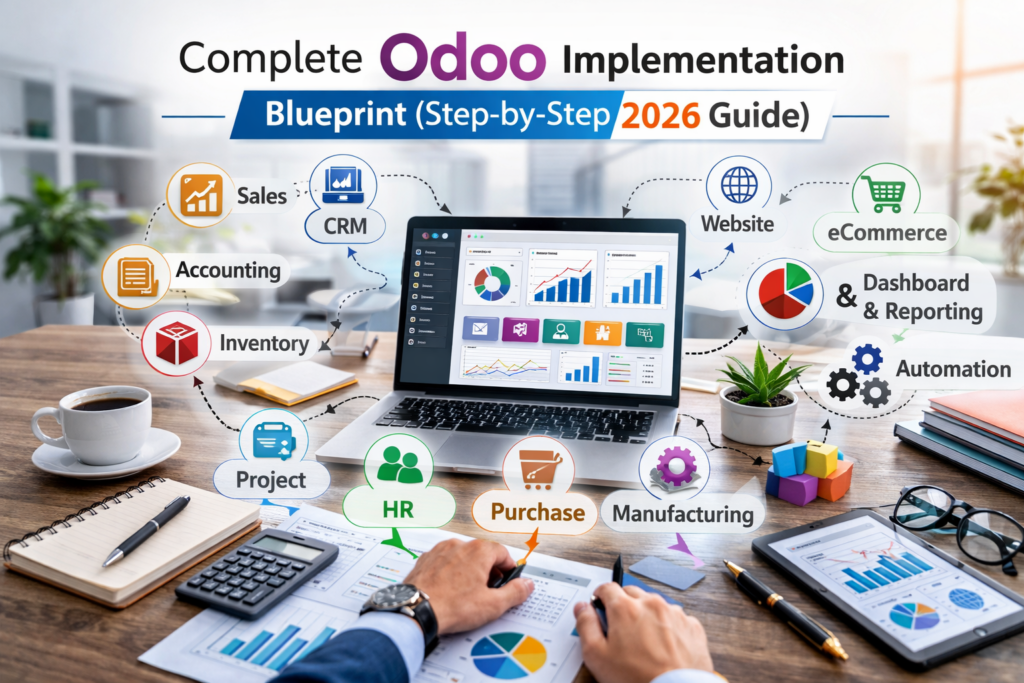
Complete Odoo Implementation Blueprint (Step by Step 2026 Guide)
Implementing an ERP system is one of the most important operational decisions a growing company can make.
Odoo has become one of the most popular ERP platforms for mid sized and scaling companies because it offers modular flexibility, integrated business applications, and the ability to customize workflows for specific industries.
However, successful ERP implementation requires more than installing software. It requires a structured strategy, clear project ownership, defined responsibilities, and a carefully planned go live process.
This guide explains the complete Odoo implementation blueprint for 2026, including the phases, roles, responsibilities, and go live preparation required for a successful deployment.
What Is Odoo Implementation
Odoo implementation is the structured process of deploying the Odoo ERP system within an organization to manage business operations such as accounting, sales, inventory, manufacturing, CRM, HR, and project management.
The implementation process typically includes:
Business requirement analysis
ERP system configuration
Module customization
Data migration
Integration with existing systems
User training
Go live preparation
A properly executed implementation ensures that Odoo aligns with the company’s workflows rather than forcing the business to adapt to rigid software limitations.
Why Odoo Implementation Planning Matters
Many ERP projects fail because companies underestimate the importance of planning and stakeholder alignment.
Without a clear implementation roadmap, organizations often face problems such as:
Poor user adoption
Data migration issues
Misconfigured workflows
Integration failures
Delays during go live
A structured implementation blueprint helps companies avoid these risks and ensures predictable deployment timelines.
The Complete Odoo Implementation Process
A modern Odoo implementation follows a phased approach that ensures each stage is properly validated before moving forward.
Phase 1 Business Discovery and Requirement Analysis
The first stage focuses on understanding the company’s operational structure, business goals, and current system limitations.
Key activities include:
Process documentation
Department workflow mapping
Pain point identification
ERP module selection
Implementation scope definition
The objective of this phase is to create a clear project blueprint before any system configuration begins.
Phase 2 Solution Design and System Architecture
Once the requirements are defined, the implementation team designs the ERP architecture.
This stage includes:
Defining module structure
Designing workflows
Identifying required customizations
Integration planning
User access structure
The solution design ensures the ERP system aligns with real business operations.
Phase 3 Odoo Configuration and Customization
In this stage the ERP system is configured according to the approved solution architecture.
Typical activities include:
Module configuration
Custom workflow development
Custom field creation
Automated process setup
Report configuration
Customization is often required for companies with industry specific workflows.
Phase 4 Data Migration and System Integration
Most organizations migrate data from legacy systems, spreadsheets, or other software platforms.
This stage includes:
Data cleansing and preparation
Migration of customers, vendors, products, and financial records
Validation of migrated data
Integration with external tools such as payment systems, eCommerce platforms, or third party applications
Accurate data migration is critical for maintaining operational continuity.
Phase 5 Testing and Quality Assurance
Testing ensures that the configured system performs correctly before deployment.
Testing stages include:
Functional testing
User acceptance testing
Workflow validation
Integration testing
This stage allows teams to identify issues before the system is deployed across the organization.
Key Roles in an Odoo Implementation Project
Successful ERP deployment requires collaboration between internal stakeholders and implementation experts.
Project Sponsor
The project sponsor is typically a senior executive responsible for approving budgets and ensuring the ERP initiative aligns with strategic goals.
Responsibilities include:
Approving project scope
Removing organizational obstacles
Monitoring project progress
Project Manager
The project manager oversees the implementation timeline and ensures coordination between departments.
Responsibilities include:
Managing project schedules
Coordinating implementation teams
Monitoring milestones
Managing communication between stakeholders
Functional Consultants
Functional consultants translate business requirements into ERP workflows.
Their responsibilities include:
Process analysis
Module configuration
User training
Testing support
Technical Consultants
Technical consultants handle the technical architecture and development aspects.
Responsibilities include:
Custom module development
System integration
Data migration scripts
Technical troubleshooting
Department Key Users
Key users represent each department during implementation.
They help ensure the ERP system reflects real operational workflows.
Responsibilities include:
Providing process inputs
Participating in testing
Supporting internal training
Preparing for Odoo Go Live
Go live preparation is one of the most critical stages in ERP implementation.
A structured checklist ensures the system is ready for deployment.
System Readiness
Before go live, organizations should confirm:
All modules are configured correctly
Integrations are operational
Workflows have been tested
Data migration has been validated
User Training Completion
Employees must be trained before the system goes live.
Training programs typically include:
Role based training sessions
Hands on system demonstrations
Process walkthroughs
Documentation and training materials
Final Data Validation
Data accuracy is essential for operational continuity.
Before launch organizations should verify:
Customer and vendor data
Inventory balances
Financial opening balances
Product catalogs
Backup and Recovery Planning
Before go live it is important to ensure system backup mechanisms are in place.
This protects business data in case unexpected issues occur after deployment.
Common Challenges in Odoo Implementation
While Odoo is flexible, implementation projects can face challenges if not managed properly.
Common risks include:
Poor requirement documentation
Underestimating customization needs
Insufficient training
Incomplete testing
Weak change management
Working with experienced Odoo implementation experts helps mitigate these risks.
How Long Does Odoo Implementation Take
The timeline depends on the size of the organization and the complexity of workflows.
Typical timelines include:
Small businesses
2 to 3 months
Mid sized companies
3 to 6 months
Large enterprises
6 to 12 months
A phased rollout approach is often used to reduce operational disruption.
Best Practices for a Successful Odoo Implementation in 2026
Organizations planning ERP deployment should follow several best practices.
1 Focus on business processes rather than software features
2 Involve department leaders early in the project
3 Invest in user training and change management
4 Conduct multiple rounds of testing
5 Work with experienced ERP consultants
These practices significantly increase the success rate of ERP projects.
Conclusion
Odoo implementation is not simply a technical project. It is a transformation of how a company manages operations, processes, and decision making.
A structured implementation blueprint that includes clear roles, phased deployment, proper testing, and strong go live preparation ensures a smooth transition.
Organizations that follow a disciplined ERP implementation strategy are far more likely to achieve the benefits of improved efficiency, real time visibility, and scalable operational control.