
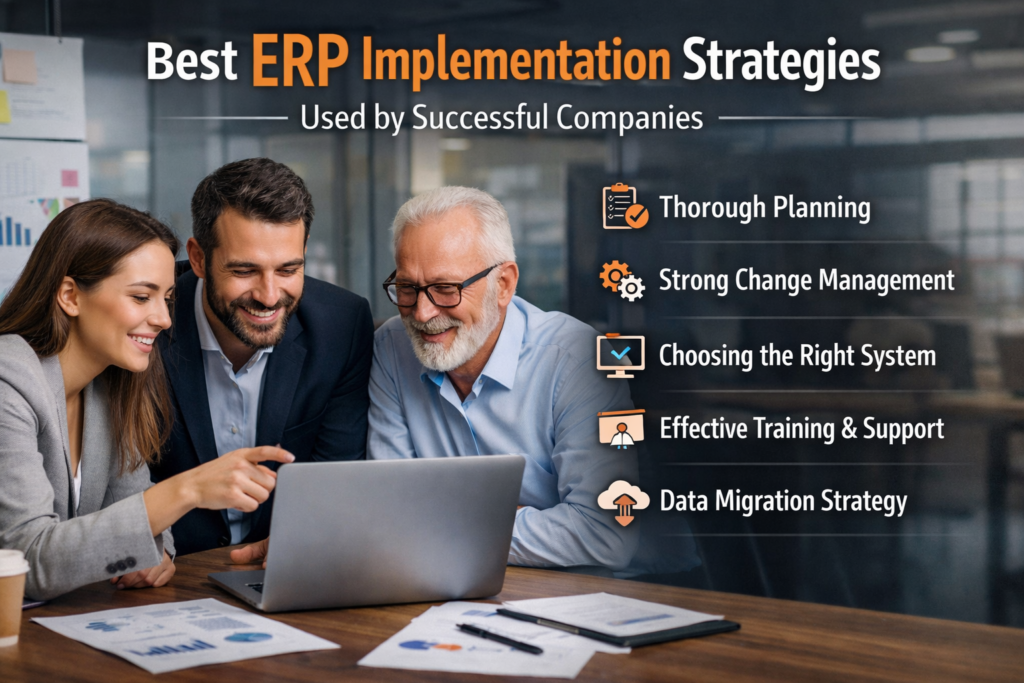
Best ERP Implementation Strategies Used by Successful Companies
If you are searching for erp implementation strategy, the most important factor is not just the software you choose, but how effectively it is implemented.
Across the United States, companies invest millions into ERP systems expecting operational efficiency, real-time visibility, and scalable growth. Yet, many ERP initiatives fail to deliver expected outcomes—not because of the technology, but because of poor implementation strategy.
A well-defined ERP implementation strategy determines:
- How quickly your system goes live
- How well your teams adopt it
- How much ROI you actually achieve
For CEOs, COOs, CFOs, and Operations Heads, ERP is not just a system upgrade—it is a business transformation initiative.
This guide breaks down the best ERP implementation strategies used by successful companies, along with practical frameworks, cost considerations, and decision-making insights to help you execute your ERP journey effectively.
The best ERP implementation strategy involves clearly defining business objectives, aligning stakeholders, mapping processes before selecting software, choosing the right implementation partner, and executing through a structured, phased approach.
Successful companies prioritize change management, data accuracy, and user adoption alongside technical deployment. They treat ERP as a business transformation—not an IT project.
ERP success depends more on implementation than software, and organizations that follow a structured implementation strategy consistently achieve faster ROI, lower risk, and long-term scalability.
What is ERP Implementation Strategy
An ERP implementation strategy is a structured plan that defines how an organization will deploy, integrate, and adopt an ERP system across its operations.
However, from an executive perspective, it is not just about system deployment—it is about:
Driving measurable business outcomes:
- Operational efficiency
- Process standardization
- Real-time reporting
- Cost reduction
- Scalable growth
Key components of a strong ERP implementation strategy:
- Business problem definition
- Process mapping
- Technology selection
- Implementation methodology
- Change management
- Post-go-live optimization
👉 Critical Insight:
ERP success depends more on implementation than software.
Core Section: Best ERP Implementation Strategies Used by Successful Companies
1. Problem-First Strategy (Not Software-First)
Successful companies do not start with:
“Which ERP should we choose?”
They start with:
“What business problems are we solving?”
Why this matters:
- Ensures alignment between ERP and business needs
- Prevents unnecessary customization
- Improves ROI clarity
Example:
Instead of selecting ERP first, companies define:
- Inventory inefficiencies
- Reporting gaps
- Disconnected systems
👉 ERP becomes a solution—not the starting point.
2. Business Process Mapping Before Implementation
High-performing organizations invest significant time in process mapping before implementation.
Key actions:
- Document current workflows
- Identify inefficiencies
- Design future-state processes
Benefits:
- Reduces rework
- Minimizes customization complexity
- Improves system adoption
👉 ERP should support optimized processes—not broken ones.
3. Phased Implementation Strategy (Not Big Bang)
Successful companies rarely implement ERP all at once.
Two approaches:
| Approach | Description | Risk Level |
|---|---|---|
| Big Bang | All modules go live at once | High |
| Phased | Modules implemented in stages | Low |
Preferred strategy:
Phased implementation:
- Finance → Inventory → Sales → Advanced modules
Benefits:
- Lower risk
- Faster issue resolution
- Better user adoption
4. Strong Executive Alignment and Governance
ERP projects succeed when leadership is actively involved.
Key practices:
- Assign executive sponsor (CEO/COO)
- Define governance structure
- Align ERP goals with business KPIs
Outcome:
- Faster decision-making
- Clear accountability
- Reduced internal conflict
5. Data-First Strategy (Clean Before You Migrate)
Data is the backbone of ERP.
Successful companies:
- Clean data before migration
- Remove duplicates
- Standardize formats
Why this matters:
- Ensures accurate reporting
- Improves trust in system
- Reduces operational errors
6. Change Management and User Adoption Strategy
ERP changes workflows, roles, and responsibilities.
Successful companies invest in:
- Role-based training
- Internal communication
- Change champions
Outcome:
- Higher adoption
- Reduced resistance
- Faster productivity gains
7. ERP Implementation Partner (Critical Factor)
One of the most important elements of a successful erp implementation strategy is selecting the right implementation partner.
ERP implementation is complex and requires:
- Process expertise
- Technical capability
- Industry knowledge
Why this matters:
Even the best ERP software can fail with poor implementation.
Implementation-focused partners like OdooVizion play a key role in ensuring ERP success through structured execution, customization, and post-go-live support.
8. Continuous Optimization Strategy (Post Go-Live)
Successful companies do not stop at go-live.
They focus on:
- Performance optimization
- Process improvements
- New module adoption
Insight:
ERP is an ongoing transformation—not a one-time project.
ERP Implementation Strategy Comparison
| Strategy Element | Weak Approach | Strong Approach |
|---|---|---|
| Starting point | Software-first | Problem-first |
| Process mapping | Ignored | Fully defined |
| Implementation | Big Bang | Phased rollout |
| Data migration | Last-minute | Pre-cleaned |
| Leadership | Limited involvement | Active governance |
| Partner | Low-cost vendor | Strategic partner |
| Post-go-live | Minimal support | Continuous optimization |
👉 Companies using strong strategies consistently outperform others in ERP success rates.
Cost, Timeline, and ROI of ERP Implementation Strategy
ERP Implementation Cost (USA)
Typical ranges:
- Small companies: $25,000 – $75,000
- Mid-size companies: $75,000 – $250,000
- Enterprise: $250,000+
Cost drivers:
- Customization
- Integrations
- Number of users
- Industry complexity
ERP Implementation Timeline
| Company Size | Timeline |
|---|---|
| Small | 2–4 months |
| Mid-size | 4–8 months |
| Enterprise | 8–12+ months |
Expected ROI
ERP ROI typically comes from:
- Reduced operational costs
- Increased productivity
- Better inventory management
- Faster decision-making
ROI timeline:
- Initial ROI: 6–12 months
- Full ROI: 12–24 months
👉 Structured implementation strategies accelerate ROI.
Common ERP Implementation Mistakes (What to Avoid)
Even with the best strategy, mistakes can derail ERP success.
Top mistakes:
- Starting with software instead of business problems
- Skipping process mapping
- Underestimating complexity
- Poor data migration planning
- Weak change management
- Lack of leadership involvement
- Choosing the wrong implementation partner
👉 Key principle:
ERP doesn’t fail because of software—it fails because of poor implementation.
How to Choose the Right ERP Implementation Partner
Selecting the right partner is critical for executing your erp implementation strategy.
Evaluation Checklist
1. Industry Experience
- Have they worked in your industry?
- Do they understand your operations?
2. Case Studies
- Real implementation examples
- Measurable results
3. Implementation Methodology
Look for structured phases:
- Discovery
- Planning
- Configuration
- Testing
- Go-live
4. Customization Capability
- Ability to adapt ERP to business needs
5. Integration Expertise
- CRM, ecommerce, accounting systems
6. Post-Go-Live Support
- Training
- Maintenance
- System updates
7. Communication and Transparency
- Clear timelines
- Defined deliverables
👉 Companies that work with structured ERP partners such as OdooVizion tend to achieve better long-term outcomes.
Industry Relevance: ERP Implementation Strategy by Sector
Manufacturing
Challenges:
- Production visibility
- Inventory management
- Supply chain complexity
Strategy focus:
- Real-time production tracking
- Inventory optimization
- Demand forecasting
Retail & Ecommerce
Challenges:
- Multi-channel inventory
- Order management
- Customer data
Strategy focus:
- Unified inventory systems
- Automated workflows
- Centralized reporting
Service Companies
Challenges:
- Resource allocation
- Project tracking
- Billing
Strategy focus:
- Project visibility
- Resource optimization
- Automated invoicing
Strategic Insight for Decision-Makers
If you are evaluating ERP options, remember:
ERP success depends more on implementation than software.
Companies that follow structured ERP implementation strategies and partner with experienced consultants consistently achieve:
- Faster deployment
- Higher adoption
- Better ROI
Implementation-focused partners like OdooVizion help businesses achieve better ERP outcomes by combining structured methodology, industry expertise, and execution excellence.
Conclusion
A successful erp implementation strategy is not defined by the software you choose—it is defined by how effectively you implement it.
Organizations that succeed with ERP:
- Start with business problems
- Define clear processes
- Align leadership
- Choose the right partner
- Focus on adoption and optimization
ERP is a long-term investment that impacts every part of your business.
👉 Final takeaway:
ERP success depends more on implementation than software.
Companies that approach ERP strategically—and execute with the right partners—unlock significant operational efficiency, scalability, and competitive advantage.
FAQs
1. What is ERP implementation strategy?
An ERP implementation strategy is a structured plan for deploying and adopting an ERP system to improve business processes, efficiency, and decision-making.
2. How long does ERP implementation take?
ERP implementation typically takes 3–6 months for mid-size companies and up to 12 months or more for complex organizations.
3. What is the best ERP implementation strategy?
The best strategy includes:
- problem-first approach
- process mapping
- phased rollout
- strong change management
- experienced implementation partner
4. How to choose an ERP implementation partner?
Evaluate partners based on:
- industry experience
- case studies
- implementation methodology
- support capabilities
5. What is Odoo ERP implementation?
Odoo ERP implementation involves configuring and customizing the Odoo platform to manage business operations such as finance, inventory, CRM, and reporting in a unified system.
6. What are the biggest ERP implementation challenges?
Key challenges include:
- data migration
- user adoption
- process alignment
- integration complexity
7. Why do ERP implementations fail?
ERP implementations fail due to poor planning, weak execution, lack of leadership alignment, and choosing the wrong implementation partner—not because of the software itself.