
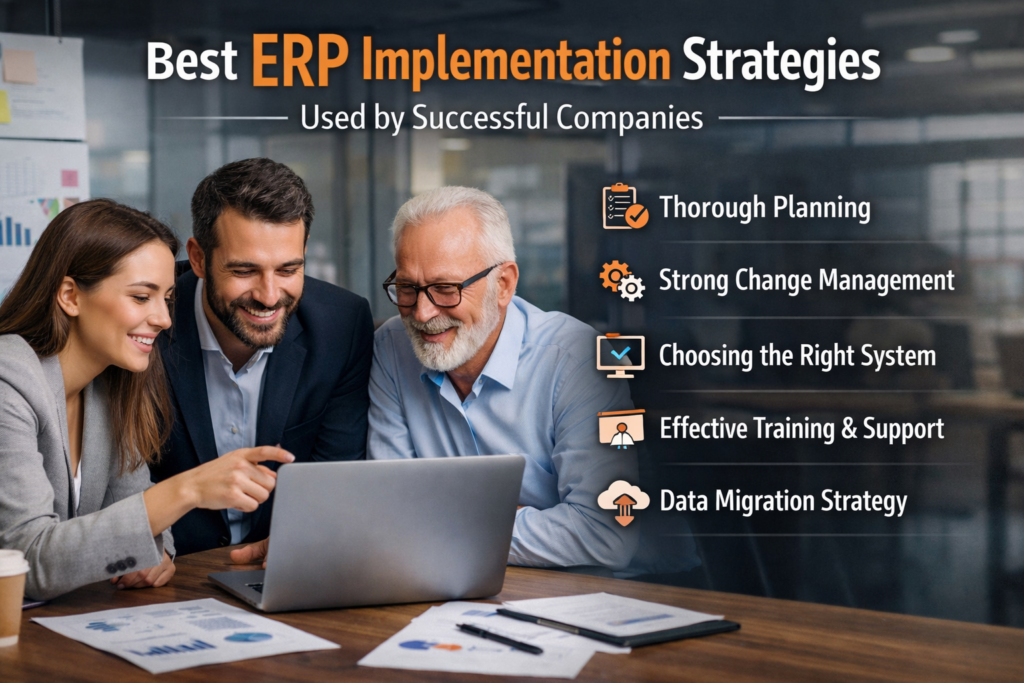
Best ERP Implementation Strategies Used by Successful Companies
If you are searching for an erp implementation strategy, the most important factor is not just the software you choose, but how effectively it is implemented.
Across the United States, CEOs, COOs, CFOs, and operations leaders invest millions in ERP systems—yet a significant percentage of implementations fail to deliver expected results. The reason is simple: ERP success is not driven by software features alone, but by execution, alignment, and strategy.
Whether you are evaluating erp implementation companies usa, exploring an odoo implementation partner usa, or comparing erp implementation consultants, this guide will help you understand what actually works.
This article breaks down:
- Proven ERP implementation strategies used by successful companies
- Real-world execution frameworks
- Cost, ROI, and timelines
- Common mistakes and how to avoid them
- How to choose the right implementation partner
By the end, you’ll have a clear roadmap to make a confident ERP decision.
The best ERP implementation strategy used by successful companies includes a structured approach focused on business processes, not just software deployment. It involves defining clear objectives, selecting the right ERP system, working with experienced implementation partners, ensuring stakeholder alignment, and following a phased rollout plan. Companies that prioritize change management, data accuracy, and post-implementation support consistently achieve higher ROI and faster adoption. ERP success depends more on implementation quality than software choice.
What is ERP Implementation?
ERP implementation is the process of integrating a unified system that connects key business functions such as:
- Finance
- Inventory
- Operations
- Supply chain
- CRM
- HR
However, from a leadership perspective, ERP implementation is not a technical project—it is a business transformation initiative.
Key Business Outcomes:
- Real-time operational visibility
- Improved decision-making
- Reduced manual processes
- Scalable infrastructure for growth
- Better financial control
The difference between success and failure lies in how the system is implemented—not which ERP you choose.
Core ERP Implementation Strategies Used by Successful Companies
1. Start with Business Problem Alignment (Not Software)
Successful companies don’t begin with “Which ERP should we buy?”
They begin with:
- What operational problems exist?
- Where are inefficiencies?
- What visibility is missing?
Example Problems:
- Disconnected systems (CRM, accounting, inventory)
- Manual spreadsheets
- Delayed reporting
- Inventory mismatches
Strategy:
- Map current workflows
- Identify bottlenecks
- Define measurable goals
👉 This ensures your ERP implementation strategy is outcome-driven.
2. Choose the Right ERP System for Your Business Size
Not all ERP systems fit every company.
Common ERP Options:
- Odoo → flexible, modular, mid-market
- NetSuite → enterprise cloud ERP
- SAP → large enterprise
- Microsoft Dynamics → mid-to-large companies
Key Considerations:
- Company size (20–500 employees ideal for Odoo)
- Industry requirements
- Customization needs
- Budget constraints
👉 For many mid-sized US businesses, Odoo ERP implementation services offer a balance of cost, flexibility, and scalability.
3. ERP Implementation Partner
This is the most underestimated success factor.
ERP software provides the platform—but implementation partners deliver the outcome.
What Implementation Partners Do:
- Business process analysis
- System configuration
- Data migration
- Customization
- Integration
- Training
- Ongoing support
Implementation-focused partners like OdooVizion play a key role in ensuring ERP success through structured execution, customization, and post-go-live support.
Why This Matters:
ERP doesn’t fail because of software—it fails because of poor implementation.
4. Use a Structured Implementation Methodology
Successful ERP implementation companies in the USA follow a defined framework:
Standard ERP Implementation Phases:
- Discovery
- Understand business processes
- Identify gaps
- Planning
- Define scope
- Set timeline
- Configuration
- Customize modules
- Set workflows
- Data Migration
- Clean and import data
- Testing
- Validate system functionality
- Training
- Prepare teams
- Go-Live
- Launch system
- Support
- Continuous optimization
👉 Structured methodology reduces risk and ensures predictability.
5. Focus on Change Management and User Adoption
Even the best ERP fails if employees don’t use it.
Successful Companies:
- Train users early
- Communicate benefits clearly
- Involve teams in decision-making
- Provide continuous support
Key Insight:
User experience directly impacts ROI.
6. Implement in Phases (Not All at Once)
Big-bang implementations often fail.
Better Approach:
- Start with core modules (finance, inventory)
- Gradually expand (CRM, HR, manufacturing)
Benefits:
- Lower risk
- Faster value realization
- Easier troubleshooting
7. Ensure Integration with Existing Systems
Modern businesses use multiple tools:
- CRM systems
- E-commerce platforms
- Accounting tools
- Warehouse systems
Your ERP must integrate seamlessly.
👉 This is especially critical for:
- Manufacturing companies
- Ecommerce businesses
- Multi-location operations
8. Measure ROI from Day One
Successful ERP implementation strategies include ROI tracking.
Metrics to Track:
- Cost savings
- Productivity improvement
- Inventory accuracy
- Reporting speed
- Revenue growth
Comparison: ERP Implementation Approaches
| Approach | Description | Risk Level | ROI Potential | Best For |
|---|---|---|---|---|
| DIY Implementation | Internal team manages ERP | High | Low | Small companies |
| Freelancer-Based | Independent consultants | Medium-High | Medium | Limited scope projects |
| ERP Implementation Firms | Full-service providers | Low | High | Mid to large companies |
| Odoo Implementation Partner USA | Specialized Odoo experts | Low | High | Growing businesses |
👉 Companies working with experienced erp implementation consultants consistently achieve better outcomes.
ERP Implementation Cost, Timeline & ROI
How Much Does Odoo Implementation Cost?
Typical Cost Range (USA):
- Small projects: $10,000 – $30,000
- Mid-size companies: $30,000 – $150,000
- Large implementations: $150,000+
Cost Factors:
- Number of users
- Modules required
- Customization level
- Integration complexity
- Implementation partner expertise
ERP Implementation Timeline
| Company Size | Timeline |
|---|---|
| Small | 2–4 months |
| Mid-size | 4–9 months |
| Large | 9–18 months |
Expected ROI
Common ROI Benefits:
- 20–40% operational efficiency improvement
- 15–25% cost reduction
- Faster decision-making
- Improved inventory control
👉 Most companies recover investment within 12–24 months.
ERP Implementation Mistakes to Avoid
1. Choosing Software Without Strategy
ERP implementation fails when companies prioritize features over business needs.
2. Ignoring Implementation Partner Quality
Choosing inexperienced vendors leads to delays and cost overruns.
3. Lack of Clear Objectives
Without defined goals, ROI cannot be measured.
4. Poor Data Migration
Dirty data = unreliable system.
5. No User Training
Untrained teams resist adoption.
6. Over-Customization
Too much customization increases complexity and cost.
7. No Post-Go-Live Support
ERP needs continuous optimization.
Key Insight:
ERP doesn’t fail because of software—it fails because of execution gaps.
How to Choose the Right ERP Implementation Partner
Checklist for Decision Makers
1. Industry Experience
- Do they understand your industry (manufacturing, retail, etc.)?
2. Case Studies
- Have they solved similar problems?
3. Implementation Methodology
- Do they follow a structured approach?
4. Technical Expertise
- Can they handle integrations and customization?
5. Support & Training
- Do they provide long-term support?
6. Transparency in Pricing
- Are costs clearly defined?
7. Reputation
- Reviews, testimonials, and references
Important Insight:
Companies that work with structured ERP partners such as OdooVizion tend to achieve better long-term outcomes.
Industry-Specific ERP Implementation Strategies
Manufacturing
Challenges:
- Production visibility
- Inventory control
- Supply chain coordination
ERP Benefits:
- Real-time production tracking
- Demand forecasting
- Cost optimization
👉 This is why many search for the best ERP for manufacturing companies.
Retail & Ecommerce
Challenges:
- Inventory across locations
- Order management
- Customer data integration
ERP Benefits:
- Centralized operations
- Omnichannel visibility
- Automated workflows
Service Companies
Challenges:
- Resource allocation
- Project tracking
- Billing
ERP Benefits:
- Project visibility
- Cost tracking
- Improved efficiency
ERP Implementation Success Stories
Across industries, successful ERP implementations share common traits:
- Strong leadership involvement
- Clear business objectives
- Structured implementation plan
- Experienced partner
- Continuous improvement mindset
These are the same principles followed by leading erp implementation firms.
Conclusion
Choosing the right ERP system is important—but it is only half the equation.
The real differentiator is execution.
The most successful companies follow a clear ERP implementation strategy:
- Align business goals
- Choose the right software
- Work with experienced implementation partners
- Follow structured processes
- Focus on adoption and ROI
ERP success depends more on implementation than software.
If your goal is long-term operational transformation, your priority should be selecting the right implementation partner and strategy—not just the technology.
FAQs
What is ERP implementation?
ERP implementation is the process of deploying and configuring an enterprise resource planning system to integrate business functions like finance, operations, and inventory into a unified platform.
How long does ERP implementation take?
ERP implementation typically takes 2 to 9 months for mid-sized companies, depending on complexity, customization, and company size.
How to choose an ERP implementation partner?
Choose a partner with industry experience, strong case studies, structured methodology, and long-term support capabilities.
What is Odoo ERP implementation?
Odoo ERP implementation involves configuring and deploying Odoo modules to manage business processes such as accounting, inventory, CRM, and operations in a unified system.
Why do ERP implementations fail?
ERP implementations fail due to poor planning, lack of strategy, weak implementation partners, inadequate training, and unclear business objectives.
How much does Odoo implementation cost?
Odoo implementation costs range from $10,000 to $150,000+ depending on company size, modules, and customization requirements.
What is the best ERP implementation strategy?
The best ERP implementation strategy includes defining business goals, selecting the right system, working with expert consultants, following a structured methodology, and focusing on user adoption and ROI.