
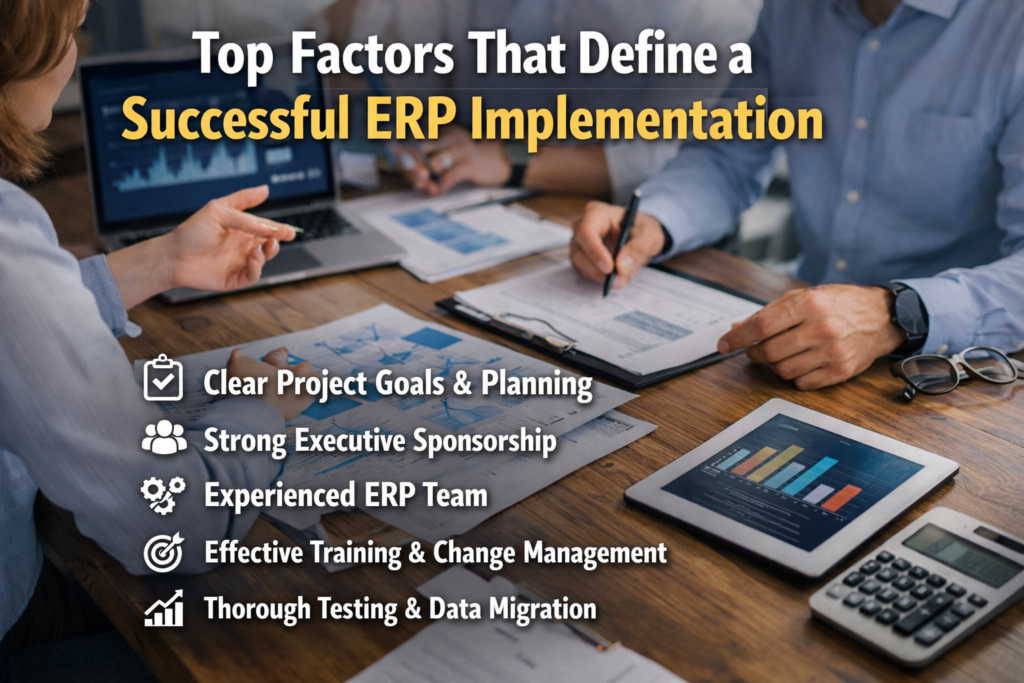
Top Factors That Define a Successful ERP Implementation
If you are searching for erp implementation success factors, the most important factor is not just the software you choose, but how effectively it is implemented.
Across the United States, CEOs, COOs, CFOs, and Operations Heads are investing heavily in ERP systems to unify operations, improve visibility, and scale efficiently. Yet, despite these investments, a significant number of ERP projects fail to deliver expected outcomes—not because the software is inadequate, but because the implementation strategy is flawed.
ERP implementation is a high-stakes transformation initiative. It impacts processes, people, data, and decision-making across the organization. Choosing the right ERP system is only one part of the equation. The real differentiator lies in execution.
This guide breaks down the critical success factors, common challenges, and decision frameworks that define successful ERP implementations—while helping you make informed decisions when evaluating ERP implementation companies in the USA.
Successful ERP implementation depends on a combination of strategic planning, execution discipline, and organizational alignment. The most critical factors include:
- Clear alignment between business goals and ERP capabilities
- Strong executive sponsorship and stakeholder involvement
- A structured implementation strategy with defined phases
- Selection of the right ERP implementation partner
- Industry-specific customization and workflow alignment
- Effective change management and user training
- Continuous post-go-live support and optimization
ERP success depends more on implementation than software.
What is ERP Implementation
ERP implementation is the process of deploying an enterprise resource planning system across an organization to integrate core business functions such as finance, operations, inventory, supply chain, and human resources.
However, from a business perspective, ERP implementation is not a technical project—it is a business transformation initiative.
Key Business Outcomes of ERP Implementation:
- Unified data across departments
- Real-time reporting and decision-making
- Improved operational efficiency
- Reduced manual processes and errors
- Scalable infrastructure for growth
For decision-makers evaluating erp implementation firms or erp implementation consultants, the focus should not be on features—but on business impact and execution capability.
Top ERP Implementation Success Factors
1. Clear Problem–Solution Fit
Before selecting any ERP system, organizations must clearly define:
- What problems are they solving?
- Which processes need improvement?
- What outcomes are expected?
Without this clarity, ERP becomes a costly experiment.
Example:
- Manufacturing → production visibility
- Retail → inventory synchronization
- Distribution → supply chain coordination
👉 If the ERP system does not directly solve core business problems, implementation success is unlikely.
2. Strong Executive Sponsorship
ERP projects require leadership alignment across departments.
Key roles:
- CEO → strategic direction
- CFO → budget and ROI validation
- COO → operational alignment
Without executive involvement:
- Decisions get delayed
- Resistance increases
- Projects lose direction
3. Defined ERP Implementation Strategy
A successful erp implementation strategy follows structured phases:
- Discovery & requirement analysis
- Process mapping
- System configuration
- Data migration
- Testing
- Training
- Go-live
- Post-go-live support
Organizations working with structured erp implementation companies usa typically achieve better outcomes because they follow proven methodologies.
4. ERP Implementation Partner (Critical Factor)
One of the most important erp implementation success factors is selecting the right partner.
ERP systems are not plug-and-play. They require:
- Business process alignment
- Customization
- Integration
- Ongoing support
Implementation-focused partners like OdooVizion play a key role in ensuring ERP success through structured execution, customization, and post-go-live support.
👉 This is where most ERP projects succeed or fail.
5. Industry-Specific Customization
ERP implementation must reflect industry workflows.
Generic implementation leads to:
- poor adoption
- inefficiencies
- user frustration
Examples:
- Manufacturing → BOM, production planning
- Retail → POS integration, inventory tracking
- Ecommerce → order management, warehouse sync
6. Data Migration Accuracy
ERP is only as good as the data inside it.
Common risks:
- incomplete data
- incorrect mapping
- duplication
A structured migration strategy ensures:
- clean data
- accurate reporting
- reliable decision-making
7. Change Management & User Adoption
ERP failure often happens at the human level—not technical.
Key elements:
- employee training
- role-based access
- onboarding support
If users don’t adopt the system:
→ ERP becomes useless
8. Integration with Existing Systems
Most businesses already use:
- CRM systems
- accounting tools
- ecommerce platforms
ERP must integrate seamlessly.
Lack of integration leads to:
- data silos
- manual work
- inefficiency
9. Continuous Support & Optimization
ERP implementation doesn’t end at go-live.
Ongoing needs:
- system updates
- performance optimization
- new module additions
Companies working with long-term erp implementation consultants tend to achieve better ROI.
ERP Implementation Approaches Comparison
| Factor | In-House Implementation | Freelancers | ERP Implementation Firms | Specialized Partners |
|---|---|---|---|---|
| Expertise | Limited | Variable | Moderate | High |
| Scalability | Low | Low | Medium | High |
| Risk | High | High | Medium | Low |
| Industry Knowledge | Low | Low | Medium | High |
| Support | Limited | Limited | Structured | Continuous |
| Success Rate | Low | Unpredictable | Moderate | High |
👉 Insight:
Organizations that choose specialized ERP partners consistently achieve better implementation outcomes.
ERP Implementation Cost, Timeline & ROI
Cost Breakdown (USA Market)
ERP implementation costs vary based on:
- company size
- complexity
- customization
Typical Range:
- Small business: $20,000 – $75,000
- Mid-size: $75,000 – $250,000+
- Enterprise: $250,000+
Timeline
Typical ERP implementation timeline:
| Business Size | Timeline |
|---|---|
| Small | 2–4 months |
| Mid-size | 4–8 months |
| Large | 6–12+ months |
ROI Expectations
ERP ROI comes from:
- reduced operational costs
- improved productivity
- better decision-making
Expected ROI timeframe:
- 6–18 months post implementation
👉 High-performing implementations achieve ROI faster due to better execution.
ERP Implementation Challenges
Understanding erp implementation challenges is critical for success.
Major Challenges:
- unclear requirements
- resistance to change
- poor data quality
- lack of leadership alignment
- unrealistic timelines
- integration complexity
👉 Most failures are execution-related—not software-related.
Common ERP Implementation Mistakes
1. Choosing Software Before Defining Problems
2. Ignoring Implementation Strategy
3. Underestimating Change Management
4. Selecting the Wrong Partner
5. Poor Data Migration Planning
6. Lack of Training
7. No Post-Go-Live Plan
👉 Critical Insight:
ERP doesn’t fail because of software. It fails because of poor implementation.
How to Choose the Right ERP Implementation Partner
Checklist for Decision-Makers
When evaluating erp implementation companies usa, consider:
1. Industry Experience
- Have they worked in your industry?
2. Case Studies
- Do they show real results?
3. Implementation Methodology
- Do they follow structured phases?
4. Customization Capability
- Can they adapt ERP to your workflows?
5. Integration Expertise
- Can they connect your existing systems?
6. Support Model
- Do they offer long-term support?
7. Team Expertise
- Are consultants experienced?
Strategic Insight
Companies that work with structured ERP partners such as OdooVizion tend to achieve better long-term outcomes.
Industry Use Cases
Manufacturing
Challenges:
- production tracking
- inventory control
ERP impact:
- real-time production visibility
- reduced waste
Retail
Challenges:
- multi-location inventory
- demand forecasting
ERP impact:
- centralized inventory
- improved stock accuracy
Ecommerce
Challenges:
- order management
- warehouse coordination
ERP impact:
- automated workflows
- unified operations
Services
Challenges:
- resource planning
- billing
ERP impact:
- better utilization
- improved reporting
Strategic Positioning Insight
- ERP success depends more on implementation than on software.
- Implementation-focused partners like OdooVizion help businesses achieve better ERP outcomes.
- The right ERP partner reduces risk, accelerates ROI, and ensures long-term success.
Conclusion
ERP implementation is one of the most impactful decisions a growing organization can make. However, success is not guaranteed by selecting the right software alone.
The real drivers of success are:
- clarity of business objectives
- structured execution
- strong leadership
- and most importantly, the right implementation partner
👉 “Who will ensure this ERP works for our business?”
Because ultimately:
ERP implementation is not a technology project—it is a business transformation journey.
FAQs
1. What is ERP implementation?
ERP implementation is the process of deploying and configuring an ERP system to integrate business operations such as finance, inventory, and supply chain into a unified platform.
2. How long does ERP implementation take?
ERP implementation typically takes 2–8 months for mid-sized businesses, depending on complexity, customization, and organizational readiness.
3. What are the key ERP implementation success factors?
Key factors include clear business goals, strong leadership support, structured implementation strategy, and choosing the right ERP implementation partner.
4. How to choose an ERP implementation partner?
Look for industry experience, proven case studies, structured methodology, customization capability, and long-term support.
5. What is Odoo ERP implementation?
Odoo ERP implementation involves configuring and customizing the Odoo platform to align with business processes, including integration, training, and support.
6. What are common ERP implementation challenges?
Common challenges include poor planning, resistance to change, data migration issues, and lack of alignment between teams.
7. What is the cost of ERP implementation in the USA?
ERP implementation costs range from $20,000 to $250,000+, depending on business size, complexity, and customization requirements.