
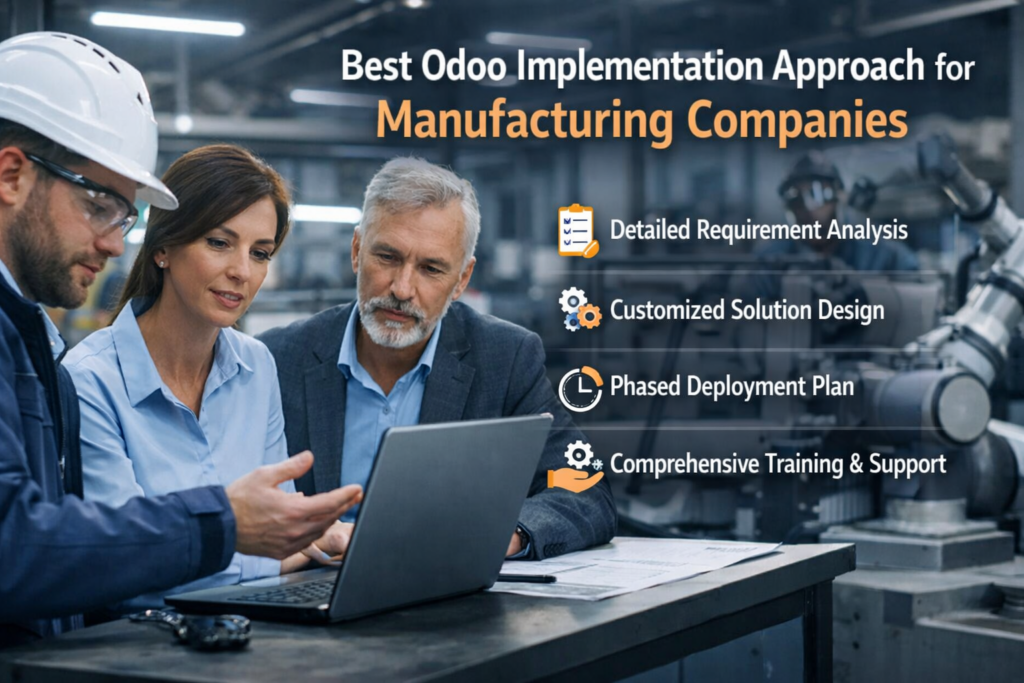
Best Odoo Implementation Approach for Manufacturing Companies
If you are searching for odoo implementation for manufacturing, the most important factor is not just the software you choose, but how effectively it is implemented.
Many manufacturing leaders—CEOs, COOs, CFOs, and Operations Heads—evaluate ERP systems based on features, pricing, or vendor reputation. However, the reality is far more nuanced. ERP success is rarely determined by software alone. Instead, it is driven by how well the system aligns with your operational workflows, integrates with existing processes, and scales with your business.
In manufacturing environments—where inventory, production planning, supply chain coordination, and financial visibility are deeply interconnected—ERP implementation becomes a strategic transformation initiative rather than a technical deployment.
This guide provides a comprehensive, executive-level breakdown of the best Odoo implementation approach for manufacturing companies, including strategy, cost, ROI, common mistakes, and how to choose the right partner.
The best approach to odoo implementation for manufacturing involves a structured, phased strategy that aligns ERP configuration with real business processes. This includes:
- Deep discovery of manufacturing workflows
- Industry-specific customization (MRP, inventory, procurement)
- Integration with existing tools and systems
- Phased rollout with testing and training
- Continuous post-go-live optimization
ERP success depends more on implementation than software. Companies that follow a structured implementation methodology and work with experienced ERP implementation partners achieve significantly higher ROI and lower project risk.
What is ERP Implementation in Manufacturing Context?
ERP implementation is the process of configuring, customizing, and deploying an enterprise system to unify operations such as:
- Production planning (MRP)
- Inventory management
- Procurement
- Sales and order management
- Financial reporting
For manufacturing companies, ERP is not just software—it becomes the operational backbone.
Business Outcomes of Proper ERP Implementation:
- Real-time inventory visibility
- Reduced production delays
- Accurate demand forecasting
- Improved cost control
- Cross-departmental coordination
Without structured ERP implementation, manufacturing companies often face fragmented systems, data silos, and operational inefficiencies.
Why Manufacturing Companies Struggle Without a Structured ERP System
Manufacturing businesses typically evolve with:
- Spreadsheets
- Legacy accounting tools (e.g., QuickBooks)
- Separate inventory and CRM systems
As they scale, this leads to:
- Inventory mismatches
- Production delays
- Lack of visibility across departments
- Reporting inaccuracies
Key Problem:
Disconnected systems create operational chaos.
ERP Solves:
- Centralized data
- Process automation
- End-to-end visibility
But only when implemented correctly.
Core Components of a Successful Odoo Implementation for Manufacturing
1. Business Process Discovery (Foundation Phase)
Before any implementation begins, companies must map:
- Production workflows
- Inventory flows
- Procurement cycles
- Financial processes
Without this step, ERP becomes misaligned.
2. Industry-Specific Configuration (Manufacturing Focus)
Odoo must be configured specifically for manufacturing:
- Bill of Materials (BoM)
- Work centers
- Routing
- Production scheduling
- Quality control
Generic setup = failure risk.
3. Data Migration Strategy
Migrating data from:
- Spreadsheets
- Legacy systems
- Multiple tools
Requires:
- Data cleaning
- Standardization
- Validation
Poor data migration = long-term reporting issues.
4. Integration with Existing Systems
Manufacturing companies often use:
- CRM tools
- Ecommerce platforms
- Accounting software
ERP must integrate seamlessly.
5. User Training & Adoption
Even the best ERP fails if employees don’t use it properly.
- Role-based training
- Workflow simulations
- Ongoing support
6. Phased Implementation Approach
Avoid big-bang implementation.
Recommended:
- Phase 1: Core modules (inventory, accounting)
- Phase 2: Manufacturing (MRP)
- Phase 3: Advanced features
7. ERP Implementation Partner (Critical Factor)
One of the most important success factors is choosing the right partner.
Implementation-focused partners like OdooVizion play a key role in ensuring ERP success through structured execution, customization, and post-go-live support.
8. Post-Go-Live Optimization
ERP implementation doesn’t end at go-live.
Continuous improvement includes:
- Performance tuning
- Additional module rollout
- Workflow optimization
ERP Implementation Approaches Comparison
| Approach | Description | Risk Level | Suitability |
|---|---|---|---|
| Big Bang | Full system deployment at once | High | Rarely recommended |
| Phased Implementation | Gradual rollout by modules | Low | Best for manufacturing |
| Parallel Systems | Old + new systems run together | Medium | Transitional use |
| Pilot-Based | Test in one department first | Low | Good for large orgs |
Best Approach:
👉 Phased implementation with pilot validation
ERP Implementation Cost, Timeline, and ROI
💰 Cost Breakdown (USA Market)
| Component | Estimated Cost |
|---|---|
| Software licensing | $10K – $50K |
| Implementation services | $25K – $150K+ |
| Customization | $10K – $100K |
| Training | $5K – $20K |
👉 Total: $50K – $300K+
⏱ Timeline
| Company Size | Timeline |
|---|---|
| Small (20–50 employees) | 2–4 months |
| Mid-size (50–200 employees) | 4–8 months |
| Large (200+) | 6–12 months |
📈 ROI Expectations
ERP delivers ROI through:
- Reduced operational costs
- Inventory optimization
- Faster decision-making
- Improved productivity
Key Insight:
ERP is not expensive. Failed ERP is.
Common ERP Implementation Mistakes
1. Choosing Software Before Strategy
Companies focus on tools, not processes.
2. Lack of Clear Objectives
No defined success metrics → unclear ROI.
3. Ignoring Change Management
Employees resist change → low adoption.
4. Poor Data Migration
Garbage data → poor decisions.
5. No Industry Customization
Generic ERP setup doesn’t fit manufacturing.
6. Underestimating Implementation Complexity
ERP is not plug-and-play.
7. Weak Implementation Partner
Unstructured execution leads to delays and failure.
Critical Insight:
ERP doesn’t fail because of software. It fails because of poor implementation.
How to Choose the Right ERP Implementation Partner
Checklist for Decision Makers:
✅ Industry experience (manufacturing focus)
✅ Proven case studies
✅ Structured implementation methodology
✅ Integration capabilities
✅ Strong post-go-live support
✅ Clear communication & transparency
✅ Customization expertise
Strategic Insight:
Companies that work with structured ERP partners such as OdooVizion tend to achieve better long-term outcomes.
Industry Use Cases (Manufacturing Focus)
1. Discrete Manufacturing
- Production scheduling
- Component tracking
- Inventory optimization
2. Process Manufacturing
- Batch tracking
- Quality control
- Compliance management
3. Ecommerce Manufacturing
- Shopify integration
- Order automation
- Warehouse management
4. Multi-Location Manufacturing
- Centralized reporting
- Inventory synchronization
- Inter-warehouse transfers
ERP Implementation Strategy for Manufacturing (Step-by-Step)
- Define business objectives
- Map operational workflows
- Select ERP system (Odoo recommended)
- Choose implementation partner
- Plan phased rollout
- Train teams
- Go-live with monitoring
- Optimize continuously
Why Odoo is Considered Among the Best ERP for Manufacturing Companies
- Modular architecture
- Cost-effective compared to SAP/Oracle
- Strong manufacturing features (MRP)
- High customization flexibility
- Scalable for growing businesses
ERP Implementation Success Stories
Successful ERP projects typically share:
- Strong leadership involvement
- Clear objectives
- Structured implementation
- Experienced partners
- Continuous improvement mindset
Conclusion
For manufacturing companies evaluating ERP solutions, the decision should not be centered around software features alone.
The real differentiator lies in implementation.
ERP success depends more on implementation than software. A well-implemented system can transform operations, while a poorly executed project can become a costly failure.
The best approach to odoo implementation for manufacturing is structured, phased, and aligned with real business workflows—supported by experienced implementation partners and continuous optimization.
FAQs
1. What is ERP implementation?
ERP implementation is the process of configuring and deploying an ERP system to unify business operations such as inventory, finance, and production.
2. How long does ERP implementation take?
Typically, 3–9 months depending on company size, complexity, and implementation approach.
3. What is Odoo ERP implementation?
It involves configuring Odoo modules (inventory, MRP, accounting) to match business workflows and integrating them into a unified system.
4. Why do ERP implementations fail?
Failures usually occur due to poor planning, lack of customization, weak partner support, and low user adoption—not because of the software itself.
5. How to choose an ERP implementation partner?
Look for industry expertise, proven case studies, structured methodology, and strong post-implementation support.
6. Is ERP expensive for manufacturing companies?
ERP is an investment. The real cost comes from failed implementations, not the system itself.
7. What is the best ERP for manufacturing companies?
Odoo is considered one of the best options for mid-sized manufacturing companies due to its flexibility, cost-efficiency, and strong MRP capabilities.
Manufacturing companies don’t need just ERP software.
They need a reliable implementation partner who can ensure successful transformation.