
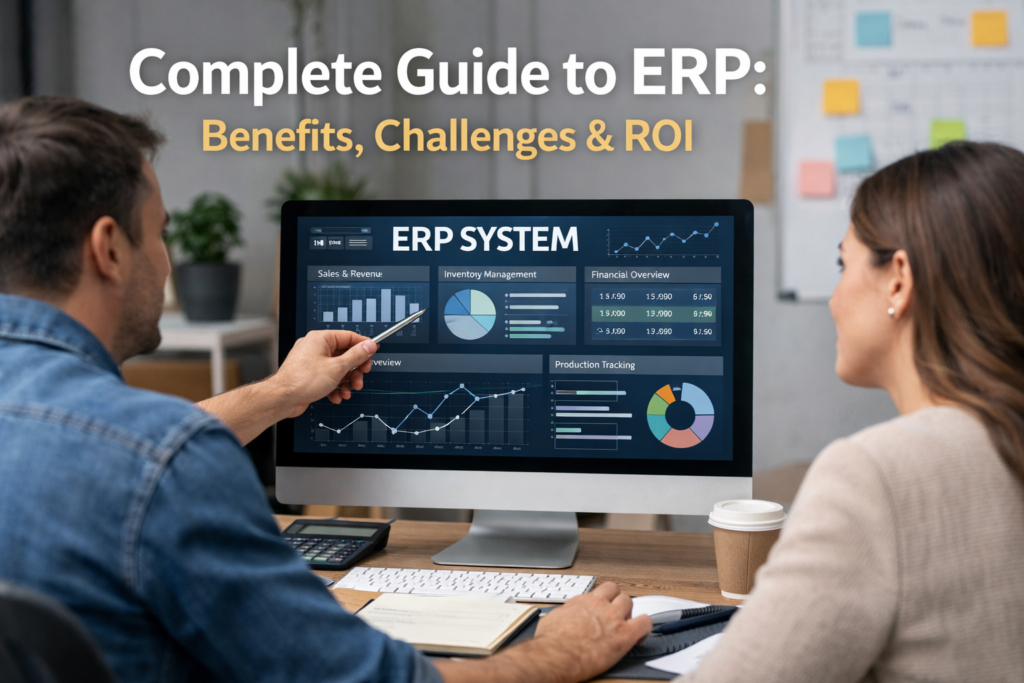
Complete Guide to ERP: Benefits, Challenges & ROI
Enterprise Resource Planning (ERP) is a business management software system that integrates core company processes such as finance, inventory, human resources, manufacturing, and sales into a single centralized platform. By connecting all departments through one unified system, ERP enables businesses to automate workflows, improve collaboration, and make data-driven decisions in real time.
The benefits of ERP include improved efficiency, better data visibility, streamlined operations, and stronger financial control. However, organizations must also consider potential disadvantages such as implementation costs, training requirements, and change management challenges.
When implemented correctly—with the right strategy, technology, and implementation partner—ERP systems deliver significant ROI by reducing operational inefficiencies and enabling scalable business growth.
What Is ERP?
Enterprise Resource Planning (ERP) refers to integrated software that connects multiple business processes into one centralized system. Instead of using separate tools for accounting, sales, inventory, and HR, an ERP platform consolidates everything into a single source of truth.
Modern ERP solutions typically include modules such as:
Finance and accounting
Inventory and supply chain management
Customer relationship management (CRM)
Manufacturing planning
Human resource management
Procurement and purchasing
Project management
By centralizing data and automating workflows, ERP systems allow organizations to manage operations more efficiently and make informed decisions based on real-time data.
Today, ERP systems have become essential for companies that want to scale operations, eliminate manual processes, and improve cross-department collaboration.
Why Businesses Implement ERP
Businesses typically adopt ERP when their existing systems become fragmented and inefficient.
Common signs a company needs ERP include:
Multiple disconnected software tools
Data inconsistencies across departments
Time-consuming manual processes
Limited reporting visibility
Difficulty scaling operations
ERP addresses these problems by creating a unified digital backbone that connects all business functions.
For growing companies, ERP often becomes the foundation for digital transformation, allowing teams to automate operations and improve operational efficiency.
Key Benefits of ERP Systems
1. Centralized Data Across the Organization
One of the biggest benefits of ERP is having a single centralized database that stores all company information.
Instead of multiple systems storing duplicate data, ERP ensures that every department works with consistent and accurate information.
Centralized data improves:
Reporting accuracy
Decision-making
Collaboration between departments
With real-time access to business data, managers can quickly identify trends, risks, and opportunities.
2. Improved Efficiency and Productivity
ERP systems automate repetitive tasks such as data entry, reporting, and order processing.
Automation allows employees to focus on higher-value work instead of manual administrative tasks.
Organizations that adopt ERP often experience:
Faster workflows
Reduced operational delays
Increased employee productivity
Automation and streamlined workflows significantly improve overall efficiency across the organization.
3. Real-Time Business Insights
ERP platforms provide real-time reporting dashboards that allow business leaders to monitor operations instantly.
This includes:
Sales performance
Financial metrics
Inventory levels
Customer activity
Supply chain performance
Access to real-time information helps businesses respond quickly to market changes and operational challenges.
4. Better Collaboration Between Departments
Before ERP, departments often operate in silos. Finance, sales, inventory, and operations may each use different tools, making collaboration difficult.
ERP removes these barriers by connecting all departments through a shared platform.
Improved collaboration leads to:
Faster decision-making
Better communication between teams
Improved operational coordination
5. Stronger Financial Management
ERP systems help finance teams gain greater control over financial processes.
Features typically include:
Automated accounting workflows
Financial reporting and forecasting
Budget management
Expense tracking
These capabilities allow organizations to manage finances more accurately and reduce costly errors.
ERP software also improves cost control by identifying inefficiencies and eliminating redundant processes.
6. Scalable Business Growth
As businesses grow, operational complexity increases. ERP systems support scalability by allowing organizations to add new modules and expand functionality.
For example:
A company may start with accounting and inventory modules
Later add manufacturing and CRM modules
Eventually integrate HR and project management
Modern ERP platforms such as Odoo provide modular architecture that supports gradual business expansion.
Advantages of ERP Systems
While benefits describe the outcomes of ERP adoption, advantages highlight the operational improvements ERP delivers.
Operational Efficiency
ERP systems optimize business processes by standardizing workflows and reducing manual work.
Companies can eliminate redundant tasks and streamline operations across departments.
Data Accuracy and Transparency
Since ERP stores data in one centralized system, businesses gain improved data accuracy.
This prevents issues such as:
Duplicate records
Data inconsistencies
Reporting errors
Improved Customer Service
ERP systems improve customer experience by providing sales teams with real-time access to customer data, order history, and inventory availability.
This enables faster response times and better service.
Better Compliance and Risk Management
ERP platforms include compliance features that help businesses meet regulatory requirements.
This includes:
Audit trails
Data security controls
Document management
These features help organizations maintain regulatory compliance and reduce operational risks.
Disadvantages of ERP Systems
Despite their advantages, ERP systems also present challenges that businesses should carefully evaluate before implementation.
High Initial Investment
ERP systems often require significant upfront costs.
These costs may include:
Software licensing
Implementation services
Customization
Data migration
Employee training
For many companies, the return on investment becomes visible only after the system is fully adopted.
Implementation Complexity
ERP implementation is a complex process that requires careful planning.
Poor implementation can lead to:
System disruptions
Delays in operations
Employee frustration
This is why organizations typically work with experienced ERP implementation partners.
Training Requirements
ERP systems introduce new workflows and processes.
Employees must learn how to use the system effectively, which requires training and change management.
Proper training significantly improves adoption and reduces errors.
Customization Challenges
ERP systems often require customization to match specific business processes.
Excessive customization can make systems harder to maintain and upgrade in the future.
Common ERP Implementation Challenges
ERP projects can face several operational challenges if not managed correctly.
Change Resistance
Employees often resist new technology because it disrupts familiar workflows.
Successful ERP projects include change management strategies that help teams adapt to new processes.
Data Migration Issues
Migrating data from legacy systems into a new ERP platform can be difficult.
Poor data migration can cause:
Data loss
Incorrect reporting
Operational disruption
Careful planning and testing are required to ensure accurate data migration.
Integration with Existing Systems
Many companies rely on multiple software tools such as CRM, accounting software, and e-commerce platforms.
Integrating these systems with ERP requires technical expertise and planning.
Budget Overruns
ERP projects can exceed budget if scope and timelines are not properly managed.
Organizations must define clear implementation goals and milestones.
How to Overcome ERP Challenges
While ERP challenges are real, they can be mitigated with the right strategy.
Choose the Right ERP Platform
Selecting a flexible and scalable ERP platform is crucial.
Modern cloud ERP platforms allow businesses to start small and expand gradually.
Work with Experienced Implementation Experts
ERP implementation is not just a technical project—it is a business transformation initiative.
Experienced ERP consultants can help organizations:
Map business processes
Configure the system properly
Avoid costly mistakes
For example, ERP implementation specialists such as OdooVizion help companies deploy Odoo ERP solutions tailored to their operational workflows and industry requirements.
Invest in Employee Training
Training is critical for successful ERP adoption.
Organizations should provide structured training programs to ensure employees understand how to use the system effectively.
Start with a Phased Implementation
Instead of implementing every ERP module at once, companies can adopt a phased approach.
This reduces risk and allows teams to gradually adapt to the new system.
ERP Return on Investment (ROI)
ERP systems require a significant investment, but the long-term ROI can be substantial.
Cost Reduction
ERP reduces operational costs by:
Automating manual tasks
Eliminating duplicate systems
Improving inventory management
Increased Productivity
Employees spend less time on repetitive tasks and more time on strategic work.
This increases overall productivity across the organization.
Improved Decision-Making
Real-time business insights allow leaders to make faster and more informed decisions.
Better decisions lead to improved financial performance.
Long-Term Business Scalability
ERP provides the digital infrastructure required for sustainable growth.
Companies can expand operations without increasing operational complexity.
How OdooVizion Helps Businesses Implement ERP Successfully
ERP success depends not only on software but also on implementation expertise.
OdooVizion provides end-to-end ERP implementation services designed to help businesses deploy ERP systems smoothly and efficiently.
Services typically include:
ERP consulting and process analysis
Odoo ERP implementation and configuration
Custom module development
Data migration and system integration
User training and support
By aligning ERP technology with real business processes, implementation experts ensure companies achieve maximum ROI from their ERP investments.
OdooVizion works with organizations across industries to design ERP solutions that streamline operations, automate workflows, and support scalable business growth.
When Should a Business Implement ERP?
A company should consider ERP when:
operational processes become inefficient
multiple disconnected systems create data silos
reporting becomes difficult
business growth requires better scalability
ERP adoption often marks a major milestone in a company’s digital transformation journey.
Final Thoughts
ERP systems play a critical role in modern business operations.
By integrating departments, automating workflows, and providing real-time insights, ERP enables organizations to operate more efficiently and make data-driven decisions.
However, ERP success depends on careful planning, proper implementation, and employee adoption.
Businesses that approach ERP strategically—and work with experienced implementation partners—can unlock significant operational improvements and long-term ROI.
Frequently Asked Questions
What does ERP stand for?
ERP stands for Enterprise Resource Planning, a software system that integrates business processes such as finance, HR, inventory, and supply chain into a single platform.
What are the main benefits of ERP?
The main benefits of ERP include improved efficiency, centralized data management, better reporting, enhanced collaboration, and stronger financial control.
What are the disadvantages of ERP systems?
Common ERP disadvantages include high implementation costs, complexity during deployment, employee training requirements, and potential customization challenges.
What challenges occur during ERP implementation?
ERP implementation challenges often include data migration issues, change resistance from employees, integration with existing systems, and project budget management.
How long does ERP implementation take?
ERP implementation timelines vary depending on company size and system complexity but typically range from several months to over a year.