
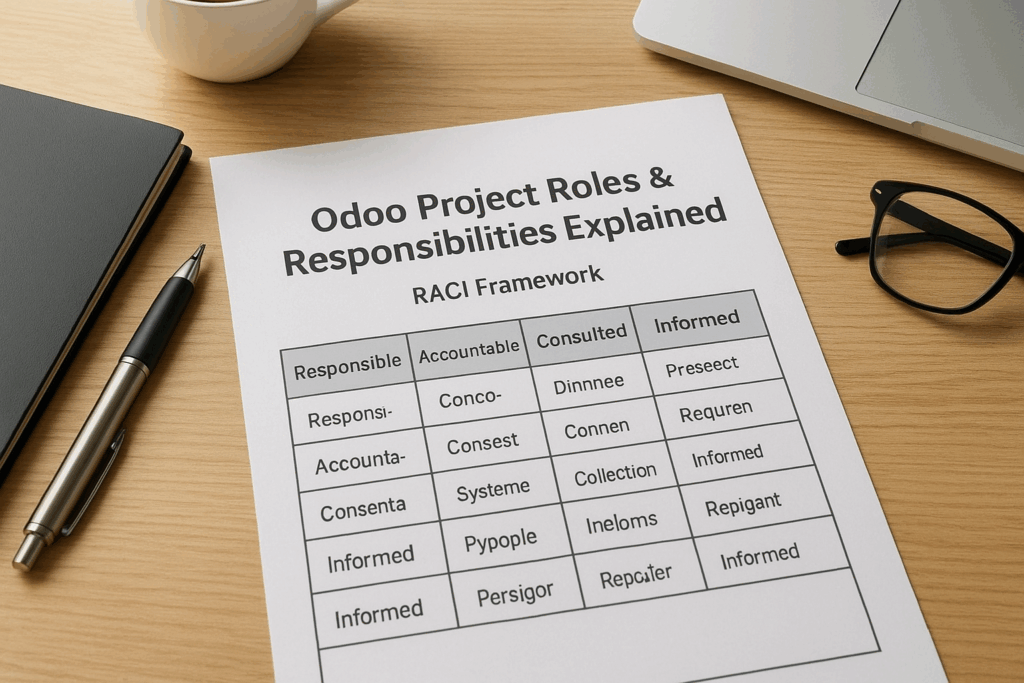
Odoo Project Roles & Responsibilities Explained (RACI Framework)
Successful ERP projects are not just about software—they’re about people. Without clearly defined ownership, even the best technology can fall short. That’s why understanding Odoo project roles and responsibilities is critical for businesses in the USA and UAE preparing for digital transformation in 2025. In this guide, we’ll explain how the RACI framework works, outline key project roles, and show how a structured team approach ensures a smooth Odoo implementation.
Why Clear Roles Matter in Odoo Projects
ERP deployments bring together business leaders, consultants, and technical teams. If responsibilities are unclear, projects risk scope creep, delays, or poor adoption. Using the RACI framework—Responsible, Accountable, Consulted, Informed—helps align stakeholders and prevent confusion.
In 2025, Odoo projects have become more complex due to advanced AI modules, deeper compliance features, and multi-region rollouts. For USA companies, this often means coordinating financial controls and regulatory reporting. For UAE businesses, it includes VAT compliance, bilingual interfaces, and multi-currency support. A well-defined RACI chart ensures every task has ownership across these contexts.
Key Roles in the Odoo Implementation Team Structure
1. Project Sponsor
Accountable (A): Provides vision, secures funding, and makes final decisions.
Typically a C-level executive ensuring alignment with strategic goals.
2. Odoo Functional Consultant
Responsible (R): Designs workflows, configures modules, and ensures business processes fit within Odoo.
Acts as a bridge between technical teams and business users.
Example: In a UAE rollout, ensuring VAT reports align with government portals.
3. Technical Consultant / Developer
Responsible (R): Handles customizations, integrations, and data migration.
Works closely with the functional consultant to translate requirements into technical solutions.
4. Business Process Owners
Consulted (C): Department leads (sales, finance, operations) who validate test scenarios and ensure the system supports real-world workflows.
Example: A USA finance lead reviewing reconciliation workflows before go-live.
5. Project Manager
Accountable (A): Oversees timelines, budgets, and deliverables.
Coordinates between client teams and Odoo consultants, ensuring progress follows the Odoo implementation guide.
6. End-Users
Informed (I): Staff who will operate the system daily.
Involved during user acceptance testing to validate usability and accuracy.
By mapping these roles into the RACI framework, businesses gain clarity on who does what, when, and how decisions are made.
How to Build a Strong Odoo Project RACI
Creating a RACI chart for your Odoo project roles and responsibilities doesn’t need to be complex. Follow these steps:
List project activities—data migration, module setup, UAT, training, go-live.
Assign RACI ownership for each activity, ensuring there is only one Accountable role per task.
Review with stakeholders to confirm agreement and avoid overlap.
Update regularly—ERP projects evolve, and so should your RACI chart.
This approach reduces miscommunication, speeds up decision-making, and creates accountability throughout the implementation journey.
Conclusion
Clarity of roles is the backbone of ERP success. By applying the RACI framework to Odoo project roles and responsibilities, companies in the USA and UAE can streamline decision-making, empower teams, and minimize implementation risks.
Ready to structure your Odoo project the right way? Partner with OdooVizion to design a clear RACI framework that ensures accountability and long-term ERP success.